Salary vs. Dividends in Canada: How Should Business Owners Pay Themselves?

If you own an incorporated business, deciding how to pay yourself can have consequences well beyond this year's tax bill. Salary and dividends are taxed differently, but they can also affect your RRSP contribution room, Canada Pension Plan (CPP) benefits, and how much money you can leave inside your corporation.
There is no rule that says salary is better than dividends, or vice versa. In some cases, the better decision may be to withdraw less money and leave more of your profits in the company. The right approach depends on your circumstances and can change over time.
What is the difference between salary and dividends?
A salary is employment income paid to you by your corporation. Assuming the amount is reasonable for the work you perform, it is generally deductible to the corporation and reduces its taxable income. You report the salary on your personal tax return and pay tax at your applicable marginal tax rate.
Dividends work differently. They are distributions made to shareholders and are not deductible to the corporation. They are generally paid from income that has already been subject to corporate tax.
To account for that corporate tax, taxable dividends received from a Canadian corporation are generally grossed up on your personal tax return and qualify for a dividend tax credit. Canada uses this system to try to achieve tax integration, so that income earned through a corporation and eventually paid to its shareholder bears roughly the same combined tax as income earned personally. That is why a lower personal tax rate on dividends does not necessarily make them the better choice.
Integration is not perfect. The result varies by province or territory and can change depending on your other income.
Salary vs. dividends: Key differences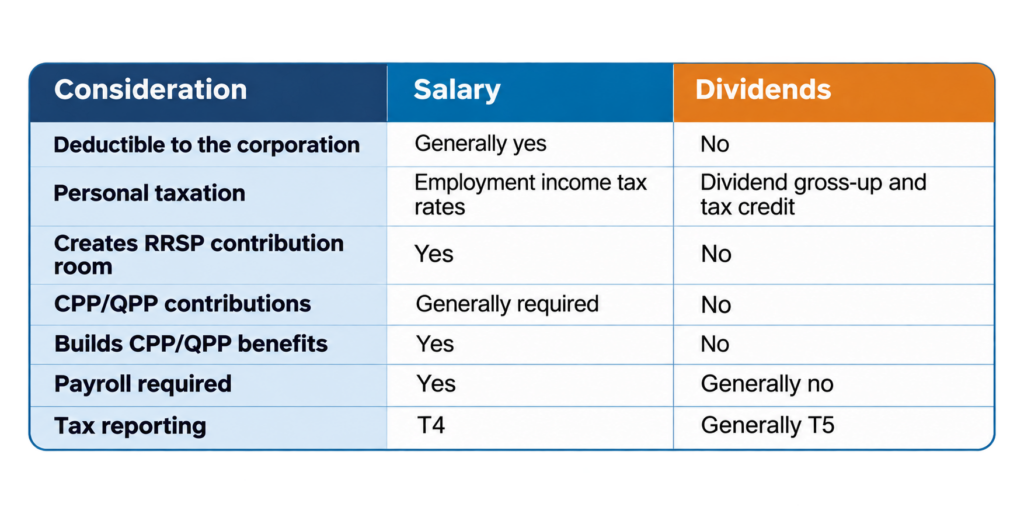
These differences provide a starting point, but they do not tell you which option will leave you better off over the long run.
Are dividends more tax efficient than salary?
Business owners sometimes assume dividends are better because the personal tax rate on dividends is lower. That comparison misses the corporate tax that has already been paid.
Suppose a Canadian-controlled private corporation (CCPC) earns active business income that qualifies for the small business deduction. The corporation may initially pay tax at a relatively low corporate rate and subsequently distribute some of the remaining profit as non-eligible dividends. The shareholder then pays personal tax on those dividends.
If the corporation pays salary instead, the reasonable salary is generally deductible in calculating its taxable income. That reduces the corporation's tax while shifting the income onto the owner's personal tax return.
Which produces the better result depends on the circumstances. Your province or territory of residence matters, as does your other income. Income subject to the general corporate tax rate introduces another variable because it may create the capacity to pay eligible dividends, which receive different personal tax treatment.
This is why it makes sense to look at corporate and personal taxes together, rather than comparing salary and dividend tax rates in isolation.
Why would you pay yourself a salary?
One of the biggest arguments for salary has nothing to do with this year's tax rate. Salary creates earned income for Registered Retirement Savings Plan (RRSP) purposes.
New RRSP contribution room is generally based on 18% of the previous year's earned income, up to the annual dollar limit and subject to applicable adjustments. Someone earning $150,000 of salary would generally generate $27,000 of new RRSP room for the following year, assuming no applicable pension adjustment or other reduction. Receiving dividends does not create RRSP room.
Whether that matters is another question. Creating RRSP room is valuable if you intend to use it, but less compelling for someone who already has considerable unused contribution room or does not expect to make RRSP contributions.
Generally speaking, paying salary and contributing to your RRSP is advantageous as a business owner.
What about CPP contributions?
Salary also results in CPP contributions for most owner-managers outside Québec, where the Québec Pension Plan (QPP) generally applies instead.
For 2026, the CPP Year's Maximum Pensionable Earnings (YMPE) is $74,600, with additional CPP contributions applying to pensionable earnings above that amount, up to $85,000.
Owner-managers can understandably look at CPP as expensive because they effectively bear the economic cost of both the employee and employer contributions. But treating those contributions as simply another tax misses an important part of the calculation.
CPP contributions can increase your future retirement pension, which is indexed to inflation and payable for life. The program also provides other benefits in qualifying circumstances, including disability and survivor benefits.
The value of making further contributions depends on your existing contribution history and how additional pensionable earnings are expected to affect your benefits. Avoiding CPP today may improve cash flow, but it also means giving up the benefits associated with those contributions.
Other reasons salary may make sense
Salary can matter in less obvious ways. Earned income can affect certain personal tax deductions, including the child care expense deduction. Lenders may also assess salary and dividend income differently when determining how much an incorporated business owner can borrow.
There is a trade-off, of course. Paying salary means operating payroll and making the required source deduction remittances to Canada Revenue Agency (CRA) or Revenu Québec. The corporation also needs to issue a T4 or RL-1 (Québec) after year-end. Depending on the circumstances, other employer payroll costs may apply.
Why would you pay yourself dividends?
The most obvious attraction of dividends is that they do not require CPP or QPP contributions. That leaves more cash available today, although it also means you are not building additional pension benefits from that income.
Dividends do not generate RRSP contribution room either. That may be relatively unimportant to someone who already has substantial RRSP assets or more unused contribution room than they expect to use. For a younger business owner who is still accumulating retirement savings, it can be a much more significant consideration.
There are also different types of dividends. Non-eligible dividends are commonly associated with income that benefited from preferential corporate tax rates, while eligible dividends generally reflect income taxed at higher corporate rates or other eligible dividend capacity. Their personal tax treatment differs accordingly.
Dividends can make administration simpler because they generally do not involve regular payroll deductions. However, tax reporting still needs to be addressed, and applicable corporate law requirements must be satisfied.
Since personal income tax is not normally withheld from dividends paid to Canadian-resident individuals, shareholders also need to make sure enough cash is available to pay their taxes, including instalments where required.
What about leaving the money in your corporation?
For many business owners, this is a more important question than salary versus dividends. If you do not need all the money your business earns to cover your personal expenses, you do not necessarily have to withdraw it. Retaining profits inside a corporation can defer personal income tax and leave more capital available for the business or for investment.
The word defer is important. Paying less tax today does not necessarily mean paying less tax permanently.
Once retained corporate cash is invested, a different set of tax rules applies. Investment income earned inside a corporation can be subject to relatively high initial tax rates, some of which may be refundable when dividends are paid. Significant passive investment income can also reduce access to the small business deduction, depending on the corporation's circumstances.
This is where the comparison becomes more interesting. Instead of simply asking whether to leave $50,000 in the company, you might compare retaining that amount with withdrawing funds to make an RRSP contribution or use available Tax-Free Savings Account (TFSA) contribution room.
An RRSP provides a tax deduction for eligible contributions and allows investments to grow tax deferred. A TFSA does not provide a deduction, but investment income and withdrawals are tax-free. Both have advantages that need to be weighed against investing through a corporation.
The decision depends partly on how long the money will remain invested and when you expect to use it. Retaining profits corporately may be appropriate, but it should not be treated as an automatic advantage simply because the initial corporate tax rate is lower.
Should you use both salary and dividends?
Sometimes, but you should not start with the assumption that a combination must be better.
An owner who wants to continue building RRSP contribution room and CPP benefits might establish an appropriate salary and take additional money as dividends when needed. Someone else may be better served primarily by salary, while another business owner may take modest compensation and retain considerably more profit inside the company.
The mix should follow from what you are trying to accomplish rather than becoming a rule of thumb that gets repeated every year.
Your circumstances can also change significantly. A compensation strategy that worked well at age 40, when you were saving aggressively for retirement, may make less sense at 60 if you have substantial RRSP savings and investments inside your corporation.
That is why we generally prefer to revisit compensation as part of ongoing corporate and personal tax planning rather than simply repeating the previous year's approach.
How do salary and dividends affect retirement planning?
A business owner's compensation strategy can shape their retirement income long before they retire. Paying salary can build RRSP room and CPP or QPP benefits, while retaining corporate profits may create a separate pool of investments that can eventually be withdrawn.
Those sources of income start interacting with each other in retirement. RRSPs may be converted to Registered Retirement Income Funds (RRIFs), corporate investments may fund dividends, and government pensions become part of the picture.
Dividends have an additional complication once Old Age Security (OAS) is relevant. Taxable Canadian dividends are included in income at their grossed-up amount, which can increase the income used to calculate the OAS recovery tax or clawback. This means a dividend strategy that appears favourable from a basic income tax perspective may produce a different outcome once government benefits are considered.
These longer-term considerations are among the reasons tax planning and financial planning work better when they are coordinated. An accountant can assess the corporation's tax position, while a financial planner can model how different compensation and withdrawal strategies affect the owner's finances over time.
For business owners approaching retirement, financial planning for incorporated business owners can help put annual tax decisions into a longer-term context.
Can you pay dividends to your spouse?
Possibly, but this is an area where old rules of thumb can get business owners into trouble.
Canada's tax on split income rules, commonly called TOSI, can apply to dividends and certain other income received by family members. Where the rules apply, the income can be subject to tax at the highest marginal rate, eliminating much of the benefit someone expected from income splitting.
There are exceptions, including for certain family members who are actively involved in the business or hold qualifying ownership interests. However, the requirements are specific, and not everyone who works in or owns shares of a family corporation will qualify.
Before changing share ownership or paying dividends to a spouse or other family member, it is worth reviewing the arrangement rather than assuming that dividends can be distributed freely among shareholders.
Paying a spouse who genuinely works in the business may be another possibility. Any salary should be reasonable in relation to the services performed and properly documented.
Be careful with shareholder loans
Another problem arises when an owner takes money out of the corporation throughout the year without deciding what those withdrawals actually represent.
Perhaps the intention is to declare a dividend later, or the withdrawals will eventually be recorded as salary or a bonus. Sometimes the bookkeeping simply shows that the shareholder now owes money to the corporation.
That last situation deserves attention. Canada's shareholder loan rules can result in amounts borrowed from a corporation being included in the shareholder's personal income. Interest-free or low-interest loans may also create taxable benefits.
There are exceptions, including in some cases where a loan is repaid within the required period. But the rules are more complicated than simply repaying the money before a deadline, and repeated borrowing and repayment can cause problems.
The practical lesson is simpler than the tax legislation. You should not use your corporation like a personal bank account without keeping track of what you are doing. If you regularly withdraw corporate cash, make sure your accountant knows about it and that there is a plan for how those withdrawals will be treated.
So, should you take salary or dividends?
There is no universal answer, and you should be cautious about compensation strategies built around rules such as always taking dividends or paying enough salary to maximize your RRSP contribution room.
Start with how much money you actually need personally and what you intend to do with the rest. From there, you can compare the corporate and personal tax costs of taking salary or dividends with the potential benefits of retaining some money inside the company.
For some owners, RRSP room and CPP benefits will make salary attractive. Others may have good reasons to rely more heavily on dividends. Sometimes, retaining additional corporate profits is more important than how the money you do withdraw is characterized.
The goal should not be to minimize one year's personal tax bill. It should be to make better decisions about what you withdraw and what you retain, with an understanding of how those decisions affect your longer-term financial position.
Get advice on paying yourself from your corporation
At Objective Tax & Accounting, we work with incorporated business owners on corporate and personal tax planning, including salary and dividend decisions. We can also help make sure transactions are properly documented and reported with monthly or quarterly bookkeeping, rather than trying to sort everything out after year-end.
When the decision is tied to retirement or how much money to retain in your corporation, Objective Financial Partners can incorporate the tax planning into a broader financial plan.
Unsure whether salary, dividends or a combination makes the most sense for you? Contact us to discuss your circumstances.
This article is intended for educational purposes only and does not constitute personalized advice. The strategies and information discussed may not be suitable for your individual situation or may not be up-to-date and current. Please seek guidance from a licensed professional for advice specific to your circumstances.